
The Rise of Ethical Banking

A new breed of banking customer is emerging. Consistent with trends in other sectors of the economy, more and more consumers are demanding that the institutions they deal with conform to the ethical standards by which they seek to conduct their own lives. But how does this apply to the financial services sector? What are the benchmarks to be used when we judge the ethics of banks? (and no, this should not be an oxymoron!)
Certainly foremost on the minds of many are the impact that banks have on the overall economy. As concentrated sources of capital, banks are the great enablers of large-scale investments in infrastructure and industrial projects. Many people are scrutinising their bank’s lending policies in these areas of the economy; they are also interested in a bank’s social capital. Recently this has been drawn sharply into focus by the questioning of the major banks on their preparedness to fund the Adani coal mine in Queensland.
There are some widely accepted measures by which people are judging their banks’ ethics:

Investments in harmful industries
Carbon neutral operations
Employment policies
Staff incentivisation
Ownership model
Investment Strategy
According to Canstar, the definition of ethical behaviour in Australia is based on institutions that do not invest in industries considered harmful to the community. These include:
fossil fuels and coal mining
weapons
tobacco
deforestation
human exploitation
gambling
animal cruelty
These are general guidelines and there are subjective differences as to what constitutes unethical practice. Every person has criteria which are more or less important to them. Some may apply a positive screening to their assessment, while others will be looking more at negative factors; i.e. avoiding the “bad guys”.
Carbon Neutral Operations
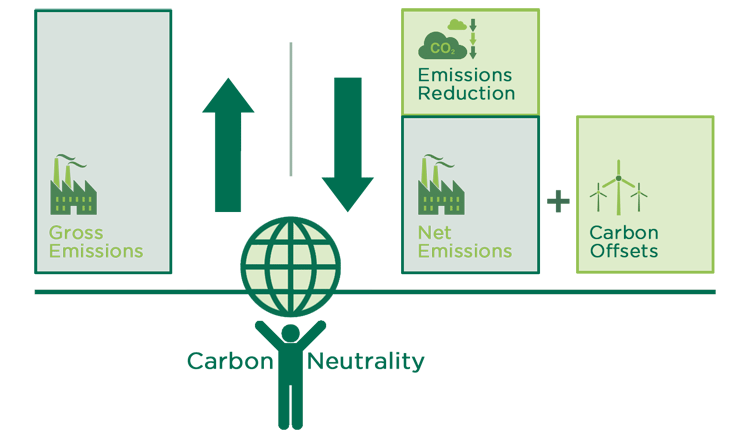
Many banks pursue the objective of carbon neutral operations. In most cases this makes common sense because investment in carbon reduction measures usually goes hand in hand with a reduction in the cost of their business operations. For example, ANZ bank recorded a reduction of 9% in its commercial electricity use in FY2017 compared with the prior year.
Measures taken by participating institutions include monitoring liquid fuel usage, air travel, electricity purchases, paper use, waste to landfill and employee commuting.
Leading ethical bank, Bank Australia states that it calculates the greenhouse gas emissions from its operations each year and then purchases carbon offsets equivalent to those emissions.
Employment Policies
Financial institutions differ widely in their employment policies. Some banks and mortgage broking firms try to drive their profitability higher by outsourcing important loan operations to low cost employment markets such as in India, the Philippines and even eastern Europe. This raises genuine concerns about the privacy of their customer’s financial data. There are also customer service impacts in dealing with overseas based call centres, or having loan approval decisions made offshore. Banks rely upon the wealth of Australians to support their businesses, so they have a social obligation to provide meaningful and well paid jobs in the community that supports them.
For these reasons those banks with a strong ethical charter keep 100% of their direct employment in Australia.
Staff Incentivisation

The recent Royal Commission into Misconduct in the Banking, Superannuation and Financial Services Industry shone a bright light on the unsavoury practices which can arise when staff remuneration is strongly related to sales outcomes. The Commission’s Interim Report published in November 2018 posed the question:
Why do staff (whether customer facing or not) need incentives to do their job unless the incentive is directed towards maximising revenue and profit?
The Commissioner also pointed out that changing culture in the banks may not be easy and may not happen quickly. But member owned banks are trying to lead the way by eschewing executive bonuses in their pay structures.
Ownership Model
The ownership structure of any institution will have a significant impact on its culture. Customer-owned institutions and banks are by nature different because they are run to benefit members rather than to profit shareholders. Customer owned or mutual bank members have voting rights on constitutional matters and profits are reinvested back into the products and services offered by the institution rather than being distributed in shareholder dividends.
Canstar has found that customers of mutual banks are generally much happier than those of their larger peers:
Customer-owned bank example: Beyond Bank
Beyond Bank is a mutual bank based in Adelaide.
“As a mutual bank, we put our customers first. Our profits go towards our customers and communities – not share market investors. We offer you lower fees, lower lending rates, higher investment rates, better banking products and support for community projects. Join the bank that gives back.”
“Mutual banks tend to be smaller in size and , being customer-owned, have a customer centric focus. This enables them to offer a personalised level of customer service that many of their members value. This makes sense because the goals of the customers, as owners, are the goals of the institution.”
Putting It All Together
In case we needed reminding, the outcome of the Royal Commission into Financial Services and Banking put into sharp focus what happens when institutions develop a culture that is far from ethical. We have developed the Loanscape Ethical Lending Matrix as a guide to prospective borrowers so that they can quickly assess how their lender is positioned within an ethical framework across a range of dimensions.
If your bank’s ethical stance is important to you then we have several lenders with which we regularly work which have been allocated a Loanscape Gold Rating!
Social Sharing
References
(2017) Carbon Neutral Program Public Disclosure Summary ANZ Bank
(2016) Sustainability and Beyond Bank Beyond Bank
Bank Australia (2017) Environmental policy Bank Australia
Hayne, K (2018) Interim Report Commonwealth of Australia
Ryan, TJ (2016) Bank or mutual bank: What's the difference? Canstar
Hurwood, J (2017) What Is Ethical Banking? How To Make The Swap Canstar
Disclaimer: This article is intended to provide general news and information only. While every care has been taken to ensure the accuracy of the information it contains, neither Loanscape nor its employees can be held liable for any inaccuracies, errors or omission. All information is current as at publication release and the publisher takes no responsibility for any factors that may change thereafter. Readers are advised to contact their financial adviser, broker or accountant before making any investment decisions and should not rely on this article as a substitute for professional advice.






Loanscape has today released its Borrowing Capacity Index for Q4/2024. It confirms the forecast trend that borrowing capacities of Australian individuals and families are recovering from their low levels which coincided with the last of the recent increases to borrowing rates initiated by the Reserve Bank of Australia.